

The most dangerous lost sale isn’t the one your salesperson couldn’t close. It’s the one your dealership never knew existed.
Imagine losing a $50,000 vehicle sale without a single phone call, email, text message, or showroom visit.
No missed lead.
No unanswered inquiry.
No frustrated customer walking out.
Your sales team did everything right. Your inventory was competitive. Your pricing was attractive. Your dealership might even have offered the best deal in town.
And you still lost the customer.
Why? Because an AI assistant recommended another dealership before the customer ever considered yours.
Sounds like science fiction?
I don’t think it will for much longer.
And if you’ve spent as much time inside dealerships as I have, you’ll understand why this possibility should get every dealer principal and general manager’s attention.
Because the next big challenge in automotive retail may not be getting more leads.
It may be making sure your dealership is even considered when AI starts deciding where customers should shop.
It’s Saturday Morning. Your Customer Has Already Started Shopping. You Just Don’t Know It.
Picture this:

A family is sitting around the kitchen table on a Saturday morning, discussing the SUV they’ve been planning to purchase.
They have two children, a trade-in worth approximately $18,000, and a budget of $50,000.
Instead of opening a dozen browser tabs and spending hours comparing dealership websites, one of them turns to an AI assistant and says:
"Find me the best SUV for my family within my budget. Compare available vehicles at nearby dealerships, look at my trade-in options, identify any additional fees, and recommend where I should buy."
That’s it.
No filling out lead forms.
No waiting for a salesperson to call back.
No searching through dozens of inventory pages.
No repeating the same questions to five different dealerships.
The AI begins researching vehicles, comparing published information, and evaluating what it can reliably establish about the buying process.
Now, today’s AI assistants cannot universally verify every dealer fee, calculate a binding trade allowance, or complete every step of a vehicle purchase. But as AI agents gain access to more reliable data sources, business systems, and authorized transaction tools, this type of shopping experience becomes increasingly plausible.
And when it does, something interesting happens.
The dealership that makes the best information available may have an advantage over the dealership offering the best deal.
Let me show you what I mean.
Two Dealerships. Two Very Different Experiences.
Let’s imagine two dealerships competing for the same customer.
Both have a vehicle that meets the family’s needs.
Both want the business.
Both have experienced employees and the ability to deliver a great buying experience.
But only one makes that experience easy to understand before a customer walks through the door.
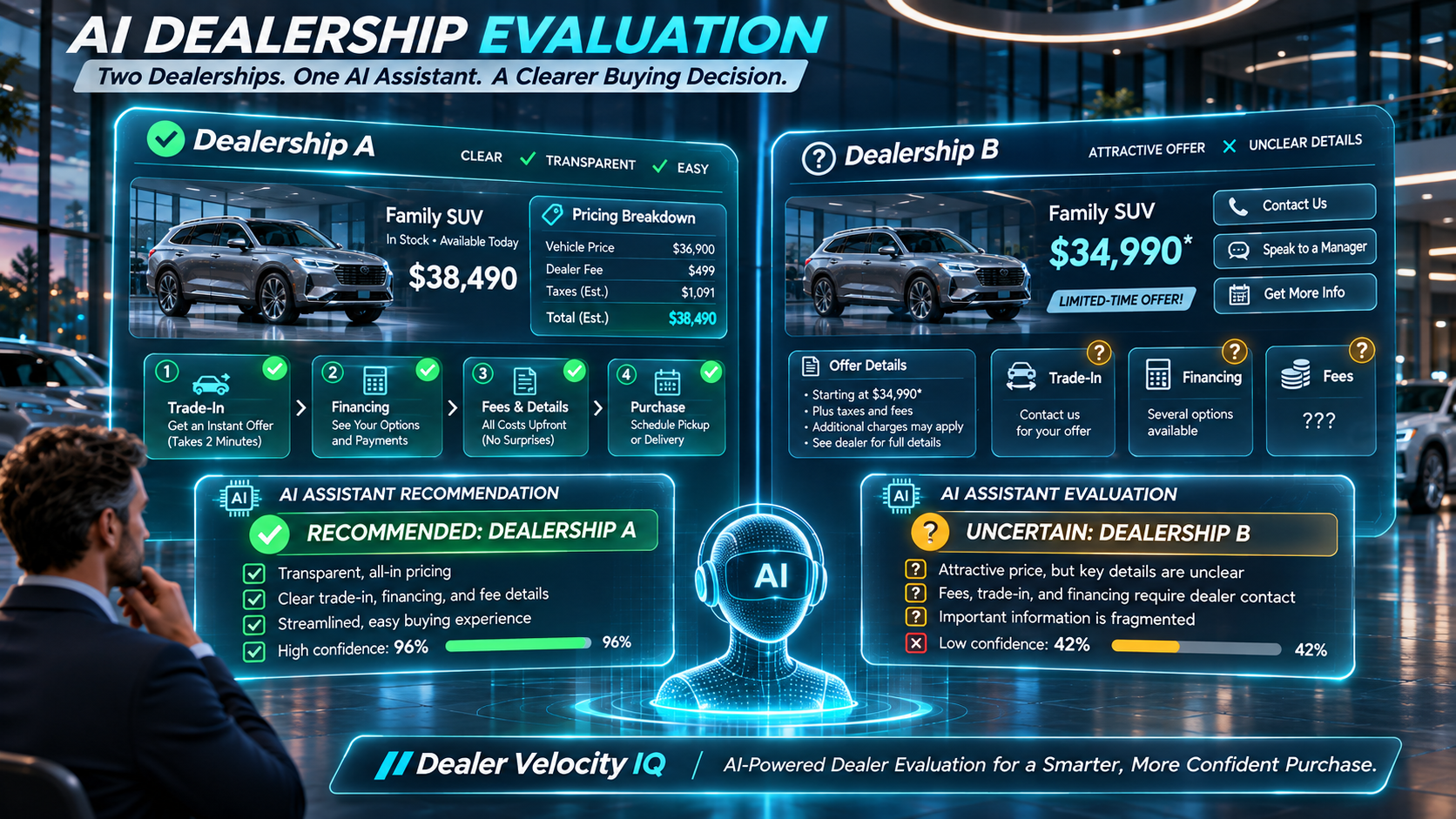
Dealership A: Everything the AI Needs to Know
The AI assistant discovers a well-equipped SUV at Dealership A.
It can find accurate vehicle details, current advertised pricing, and clearly explained fees. The dealership publishes how its trade-in appraisal process works and what customers should expect when discussing financing.
The AI identifies the steps required to move forward, along with the questions that still need confirmation from dealership personnel.
Instead of running into dead ends, it finds a clear path.
The assistant reports back:
"I found an SUV that matches your needs and budget. The dealership provides clear information about its pricing, explains its trade-in process, and outlines the next steps for financing. Here's what we know, what still needs confirmation, and how you can proceed."
The customer feels informed.
The process feels manageable.
The dealership feels trustworthy.
And the customer hasn’t spoken with a salesperson yet.
Dealership B: The Better Deal Nobody Discovers
Now the AI assistant visits Dealership B.
It finds another beautiful SUV.
Same model. Similar mileage. Comparable equipment.
And here’s the twist.
Dealership B has a lower advertised price.
Naturally, the AI looks closer.
But then the questions begin.
What’s the actual out-the-door price?
Are there additional dealer-installed accessories or mandatory fees?
How does the trade-in appraisal process work?
Can the customer start the purchase remotely?
What happens after a credit application is submitted?
What documentation will the customer need?
How long should the process take?
The answers aren’t readily available.
Instead, the AI encounters:
“Contact the dealership for details.”
“See your sales manager.”
“Visit our showroom for final pricing.”
“Submit your information and someone will contact you.”
Now, there’s nothing inherently wrong with a dealership requiring human involvement. Some numbers must be verified, some decisions require approvals, and certain transactions cannot responsibly be completed without a person.
But there’s a significant difference between a process that requires human approval and a process nobody can explain.
Dealership B might have an outstanding sales team.
Its finance department might have excellent lender relationships.
Its used car manager might offer the family another $1,500 for their trade.
And its final deal might be thousands of dollars better.
But the AI has no reliable way to establish those advantages.
So when the customer asks, “Which dealership should we start with?”
The assistant may recommend Dealership A.
Not because Dealership A necessarily offers the better deal.
Not because Dealership B has inferior people.
But because Dealership A is easier to evaluate, easier to understand, and easier to take the next step with.
And that’s the part that concerns me.
Dealership B never got a chance to compete.
The Most Expensive Lost Lead Is the One That Never Existed
For decades, dealers have measured lost opportunities through familiar signals.
Missed calls.
Unanswered internet leads.
Poor appointment-show rates.
Slow BDC follow-up.
Customers leaving without purchasing.
We track those numbers because we know every missed opportunity has a cost.
But what happens when the customer never contacts your dealership in the first place?
There’s no lead in the CRM.
No missed call on the phone report.
No opportunity assigned to a salesperson.
No appointment that failed to show.
No manager asking why the deal didn’t close.
The customer simply asks an AI assistant where to buy a car.
And the assistant recommends somewhere else.
Your dealership didn’t lose the customer during the sales process. It lost the opportunity to participate in the sales process.
Think about how difficult that problem would be to identify.
Your CRM can’t report on a conversation that never reached it.
Your BDC can’t follow up with someone who never contacted the store.
And your general manager can’t review a lost deal that nobody knew was on the table.
We’ve spent years improving how dealerships respond to opportunities.
Now we need to start thinking about how dealerships become visible and understandable to the systems that may increasingly influence which opportunities reach us at all.
AI Doesn’t Need Your Dealership to Be Perfect. It Needs Your Dealership to Be Understandable.
I want to make an important distinction here.
I’m not suggesting every dealership should publish its confidential pricing strategy, expose internal systems, or allow an outside AI agent to negotiate deals without supervision.
Absolutely not.
Every dealership needs to protect its information, its customers, and its business decisions.
But consider how much of the customer experience can be explained without revealing anything confidential.
Does your dealership clearly communicate its advertised pricing and applicable fees?
Can a customer understand how a trade-in evaluation works?
Can someone determine whether a vehicle is available, subject to confirmation?
Is there a straightforward way to request an accurate out-the-door quote?
Can customers understand the financing process without being promised an approval or an interest rate?
And when a question requires human judgment, is there a clear way to reach the right person?
These aren’t unreasonable expectations.
They’re the kinds of questions good salespeople answer every day.
The problem is that dealerships have traditionally depended on a conversation with an employee to make much of that knowledge accessible.
In an AI-assisted shopping world, the ability to communicate that knowledge before the first human conversation could become a serious competitive advantage.
And that brings us to a much bigger problem.
Your Dealership Has Plenty of Intelligence. It’s Just Trapped in Different Places.
Walk into any successful dealership, and you’ll discover something impressive.
An enormous amount of intelligence exists inside that building.
Your used car manager can look at a vehicle and recognize factors that affect its trade value.
Your sales manager knows how to structure a deal that works for the customer and the dealership.
Your finance manager understands lender programs, documentation requirements, and the complications that can slow down an approval.
Your best salesperson knows how to listen, identify what matters to a family, and build the trust necessary to earn their business.
That’s real intelligence.
And no amount of AI hype should diminish its value.
But here’s the question I’ve been asking for years.
Where does all that knowledge live when the people who possess it aren’t available?
Some of it is in the CRM.
Some lives in the DMS.
Some is buried inside desking applications, inventory tools, spreadsheets, and emails.
And plenty of it exists only in conversations between employees.
Every department has valuable information.
But the dealership as a whole doesn’t always have access to that collective knowledge when it needs it.
In Part 1 of AI on the Lot, I called this the dealership’s memory problem.
In Part 2, we explored what happens when a customer asks a simple question and the dealership can’t respond quickly enough.
Now consider the next evolution of those two challenges.
What happens when the person asking questions isn’t a person at all, but an AI assistant acting on that person’s behalf?
If the information is disconnected, the experience becomes difficult to explain.
If the answers aren’t accessible, the process becomes difficult to evaluate.
And if the AI can’t establish why your dealership is a compelling option, your dealership may never make the customer’s shortlist.
That’s why I believe the future of automotive AI is much bigger than answering website chats or automating follow-up messages.
The Next Generation of Dealership Technology Needs One Connected Brain
At Dealer Velocity IQ, we’re building around a simple belief:

A dealership shouldn’t need ten disconnected systems to operate like one intelligent business.
That’s the thinking behind VELO Brain, the shared intelligence we’re developing as part of our Dealer Velocity One platform.
Our vision isn’t to replace the dealership’s existing technology.
It’s to connect the right information across the dealership, support employees with useful context, and make the customer journey more consistent from one department to another.
Think about how that could change a typical vehicle purchase.
A customer begins by asking about an SUV.
Velocity Engage is being designed to handle appropriate customer inquiries across supported communication channels, answer questions using available and verified information, and route pricing, financing, or other matters requiring judgment to the right employee.
When that customer arrives at the dealership, Velocity Showroom is designed to help the salesperson understand the customer’s needs, identify relevant inventory, and share useful context with management.
When the conversation moves to numbers, Velocity Desk is being developed to help organize deal information, explore potential structures, and support the sales manager’s decision-making and approval process.
And across those interactions, VELO Brain is intended to provide the connected intelligence that helps information travel with the customer instead of remaining trapped inside individual departments.
One customer journey.
Connected information.
Smarter decisions.
With the right human oversight at every critical step.
Now imagine taking that same philosophy beyond internal operations.
As customer-facing AI systems become more capable, dealerships will need ways to make appropriate, authorized information understandable and accessible to those systems too.
That doesn’t mean giving every AI agent unrestricted access to your DMS, customer records, or deal structures.
It means building toward a future where accurate information can be shared through secure, controlled, and reliable interfaces, while sensitive information and business decisions remain protected.
The goal isn’t to let AI run the dealership. It’s to make the dealership intelligent enough to work effectively in a world where customers increasingly use AI.
And that’s a very different technology strategy from simply adding another chatbot to your website.
Your Best Salesperson Is Still Your Biggest Advantage
Let me be very clear about something.
I don’t believe the future of automotive retail belongs to dealerships that eliminate people from the buying process.
Buying a vehicle is a major financial decision.
Customers still need trust.
They still need reassurance.
They still need someone who understands their situation, explains their options, and takes responsibility when something needs attention.
A great salesperson provides something an automated recommendation cannot fully replace.
A great sales manager knows that a deal isn’t always just a collection of numbers.
And a great finance manager understands the importance of helping customers make informed decisions.
Those strengths matter.
But imagine what happens when the technology surrounding those people becomes dramatically better at connecting information.
The salesperson doesn’t spend the first fifteen minutes asking questions the customer has already answered.
The manager doesn’t have to reconstruct the customer’s entire journey from scattered notes.
The finance team receives the relevant, authorized information needed to prepare for the conversation.
And the dealership can communicate more clearly with customers before they arrive.
AI shouldn’t replace the experience of your best employees. It should help the entire dealership benefit from that experience.
That’s the opportunity I see.
The Real Competition Is No Longer Just Dealership A Versus Dealership B
For years, we’ve thought about competition in straightforward terms.
Our inventory versus theirs.
Our pricing versus theirs.
Our advertising versus theirs.
Our sales team versus theirs.
Those factors will continue to matter.
But another competitive dimension is emerging.
Clarity versus confusion.
Connected workflows versus disconnected departments.
Reliable information versus unanswered questions.
And potentially, dealerships that AI assistants can confidently navigate versus dealerships those assistants struggle to evaluate.
That doesn’t mean the dealership with the most technology will automatically win.
It means technology must help dealerships communicate their actual strengths.
A lower price doesn’t help if nobody can determine the final numbers.
A generous trade allowance doesn’t help if the customer never learns how to request an appraisal.
Excellent customer service doesn’t help a shopper choose your dealership if the process appears confusing or inaccessible.
You cannot compete on advantages the customer never gets a chance to discover.
And as more of the shopping journey moves through AI-assisted research, making those advantages discoverable may become just as important as delivering them.
Three Questions Every Dealer Principal Should Be Asking Today
We don’t need to wait for fully autonomous car-buying agents to start preparing.
I’d encourage every dealer principal, general manager, and dealership technology leader to ask three questions.
1. Can someone understand our buying process without speaking to five different people?
Look at your website and customer communications through the eyes of someone who knows nothing about your store.
Are your processes clear? Are your vehicle details reliable? Can customers identify what happens next?
If a customer can’t find the answers, an AI assistant working from the same information may struggle too.
2. Does our dealership share intelligence across departments, or simply move customers between them?
Every handoff creates an opportunity to lose context.
When the customer moves from the BDC to the showroom, from the salesperson to the desk, or from sales to finance, how much information follows them?
And how much do they have to repeat?
3. Are we building a connected dealership or just purchasing more disconnected AI tools?
It’s easy to buy an AI-powered phone assistant.
Or add an AI chatbot.
Or purchase another reporting platform promising actionable intelligence.
Individually, those tools may provide value.
But if none of them shares meaningful information with the others, have we really transformed the dealership?
Or have we simply added more software?
The goal should be a dealership that operates more intelligently as a whole, not a collection of independent applications each claiming to be intelligent.
The Next Customer May Never Visit Your Website
Here’s the thought I want to leave you with.
For years, automotive digital marketing has focused on getting customers to visit dealership websites.
We’ve invested in search rankings, paid advertising, inventory merchandising, lead forms, and conversion optimization.
And those investments still matter.
But the next customer journey may look different.
A customer asks an AI assistant to research the market.
The assistant compares vehicles, available information, dealership processes, and purchasing options.
It produces a shortlist.
It recommends where to begin.
And only then does the customer decide which dealership deserves a call, an appointment, or a visit.
Your dealership website may still be one of the information sources behind that decision.
But the customer might never personally browse it.
The AI may become the first visitor your dealership needs to impress.
That doesn’t mean AI assistants will always make the right recommendation. They can misunderstand information, rely on outdated details, or overlook a better offer.
But it does mean dealerships should be thinking seriously about the quality, accessibility, and reliability of the information they make available.
Because when a customer delegates part of the shopping process to an AI assistant, your dealership is no longer communicating only with the buyer.
You’re also competing to be understood by the technology helping that buyer decide.
And that changes the game.
At Dealer Velocity IQ, we’re building toward that future.
A future where dealership intelligence isn’t trapped in separate systems.
Where employees have the context they need to make better decisions.
Where customers don’t have to start over every time they reach a different department.
And where technology helps dealerships present their real strengths clearly, consistently, and intelligently.
Not by removing the human element.
But by making the entire dealership work better together.
Because the next revolution in automotive retail won’t simply be about having an AI chatbot on your website.
It will be about whether your entire dealership is ready to compete in an AI-driven world.
And when your next potential customer’s AI assistant starts comparing dealerships, I believe one question will matter more than ever:
Will your dealership give it a reason to recommend you?
Dealer Velocity IQ | One Brain. One Dealership. Smarter Decisions.
AI on the Lot is an ongoing series exploring how artificial intelligence can transform dealership operations while keeping experienced automotive professionals at the center of the customer experience.