
AI on the Lot : Your Dealership Doesn’t Have a People Problem. It Has a Memory Problem.
By Beshoy “Besho” Fadlalha | Founder & CEO, Dealer Velocity IQ
October 28, 2026 | AI on the Lot Series
Every dealership has that one person who seems to know everything.
They know which customer’s lease expires in March. They know which lender is most likely to approve a challenging deal. They remember the customer who mentioned wanting to upgrade when the new models arrive. And they know the service customer who’s been dealing with transmission problems for six months and might finally be ready for something new.
That person is invaluable.
Then one day, they accept a position at another dealership.
And just like that, years of knowledge, customer relationships, operational experience, and missed opportunities walk out the front door.
I’ve spent more than a decade in automotive retail, and I’ve seen firsthand how much dealerships depend on what their people remember rather than what their systems actually know.
That is one of the biggest problems facing our industry today. And it is exactly the kind of problem artificial intelligence can help us solve.
Not a people problem.
A memory problem.
The Hidden Cost of What Your Dealership Forgets
Think about everything that happens inside a dealership on any given day.
Hundreds of customer interactions. Incoming calls. Website inquiries. Text messages. Test drives. Trade appraisals. Credit applications. Service appointments. Follow-up conversations.
Every interaction tells us something valuable about a customer.
But where does that knowledge go?
Some of it ends up in the CRM. Some lives inside the DMS. Some is buried in text messages or email threads. And far too much exists only in the minds of individual employees.
The information isn’t necessarily missing. It’s disconnected.
A salesperson learns what matters most to a buyer, but the desk only receives a stock number and trade information. A finance manager discovers something important about a customer’s financing needs, but that context never reaches the next department. A service advisor recognizes an expensive repair ahead, but nobody on the sales floor knows there’s an opportunity to help the customer explore a replacement vehicle.
Each department does its job.
But the dealership as a whole keeps forgetting what it has already learned.
And every forgotten detail represents a potential missed opportunity, an unnecessary delay, or a customer experience that could have been better.
AI Has Two Superpowers Dealerships Desperately Need
Forget the science-fiction hype for a moment.
In practical dealership operations, AI offers two incredibly valuable capabilities:
1. The ability to retain and connect information across the customer journey.
2. The ability to identify opportunities and help people act on them at the right moment.
Imagine a dealership that remembers the customer who said, “Call me in the spring.”
One that identifies an unanswered Friday-evening lead before the weekend slips away.
One that recognizes when a service customer might benefit from exploring a newer vehicle.
One where the sales manager doesn’t have to spend the first hour of every morning digging through reports to figure out which opportunities deserve attention.
And one where the information collected during a customer’s first conversation is available, with the proper permissions, to every department that serves them afterward.
This isn’t about putting robots on the showroom floor.
It’s about giving your dealership a shared memory and making that intelligence available when your employees need it most.
A Walk Through the AI-Powered Dealership
The opportunities become much clearer when you look at the dealership one department at a time.
Business Development Center: Every Lead Deserves a Response
A customer submits an inquiry at 9:45 p.m.
Does your dealership respond immediately, or does that lead sit untouched until someone opens the CRM the next morning?
AI-assisted engagement can help dealerships respond quickly, qualify interest, suggest appointments, and maintain appropriate follow-up based on customer preferences and consent.
Your BDC team remains responsible for building relationships and converting opportunities. AI helps make sure fewer opportunities disappear before those relationships even begin.
Phone Operations: Every Call Matters
It’s Saturday afternoon. The showroom is busy. Your team is juggling appointments, walk-ins, and customers already in the buying process.
Meanwhile, the phone rings.
And rings.
An AI voice assistant can help answer routine questions, identify customer needs, collect relevant information, and coordinate appointments when employees are unavailable.
The objective isn’t to replace the people answering your phones.
It’s to make sure your dealership remains responsive even when every employee is helping someone else.
Showroom: Stop Making Customers Repeat Themselves
A customer has already explained their budget, driving habits, trade-in situation, and preferred vehicle.
Why should they have to explain everything again when the conversation moves to the sales manager?
With connected customer intelligence, the information collected during the sales process can follow the customer through each authorized handoff.
Less repetition. Fewer misunderstandings. More time focused on the customer.
The Sales Desk: Better Information, Better Decisions
Experienced sales managers develop instincts that are difficult to replace.
But even the best manager cannot instantly recall every comparable deal, lender outcome, trade scenario, and historical sales pattern.
AI can help surface relevant information, identify potential deal structures, and provide recommendations based on the dealership’s own operating history.
The manager still makes the decision.
The difference is that the decision can be informed by more than memory and instinct alone.
Finance & Insurance: Smarter Preparation
F&I professionals understand that getting a deal funded requires experience, judgment, and knowledge of lender requirements.
AI can help analyze permitted information, compare financing possibilities, and identify lenders that may be a better fit based on historical outcomes and applicable programs.
That means less time exploring unlikely paths and more time focusing on viable options.
Of course, credit-related decisions must always respect customer consent, regulatory requirements, lender policies, and appropriate human oversight.
AI should support sound financial decisions, never become an excuse to bypass them.
Service Department: Opportunities Already in Your Building
Consider a customer who brings in a six-year-old vehicle with rising mileage and a major repair approaching.
Your service team knows the vehicle.
Your sales team knows the available inventory.
Your finance team understands the potential payment options.
But do those departments share enough information to recognize when a replacement vehicle might genuinely serve that customer’s interests?
AI can help connect these signals and bring potential opportunities to the right employee’s attention.
Done properly, this isn’t about pressuring service customers into buying something.
It’s about identifying meaningful opportunities to provide solutions before customers even realize those options exist.
Marketing: Turn Inventory Into Timely Engagement
A desirable vehicle arrives on the lot.
How long before potential customers know about it?
AI-assisted marketing can help generate vehicle-specific content, prepare videos and social campaigns, and identify inquiries that deserve follow-up.
The goal isn’t simply producing more content.
It’s connecting marketing activity to real customer interest, meaningful conversations, and ultimately measurable dealership outcomes.
Management: Ask Better Questions. Get Actionable Answers.
Imagine walking into your dealership on Monday morning and asking:
“Which customers should we contact today?”
“Which opportunities are waiting too long for a response?”
“What deals need management attention?”
“Which service appointments might present a legitimate trade opportunity?”
Instead of navigating five different systems and assembling reports manually, imagine receiving a prioritized picture of what’s happening across your store.
Not just another dashboard.
Actionable intelligence that helps managers manage.
Here’s What AI Will Never Replace
Let me be clear about something.
AI will not replace the salesperson who earns a customer’s trust.
It won’t replace the manager who helps a nervous buyer feel comfortable about a difficult decision.
It won’t replace the finance professional who patiently explains the customer’s options.
And it certainly won’t replace the experience, empathy, accountability, and human connection that make great dealerships successful.
I’ve spent years managing dealership teams. I know that great people are the foundation of this industry.
The purpose of AI isn’t to eliminate the human element. It’s to give our people more time to be human.
Less chasing information.
Less repetitive data entry.
Less searching across disconnected applications.
More selling. More relationship building. More coaching. More attention to the customers standing right in front of us.
The dealerships that understand this distinction will be in a much better position to benefit from AI.
The Biggest Mistake Dealerships Can Make: Ten Tools, Ten Different Brains
Here’s where I believe our industry needs to be especially careful.
Almost every technology vendor is introducing some form of AI.
Your CRM provider has AI.
Your phone provider has AI.
Your marketing platform has AI.
Your desking solution is adding AI.
Individually, those capabilities may be valuable.
But what happens when none of them communicates effectively with the others?
You end up with ten different tools, ten separate sources of intelligence, and ten different versions of the same customer.
You’ve invested in artificial intelligence, but your dealership still has no shared memory.
That isn’t transformation.
It’s fragmentation with a bigger software bill.
The real opportunity isn’t simply adding AI features to individual applications.
It’s connecting the information your dealership already has so that every department can benefit from what the others have learned.
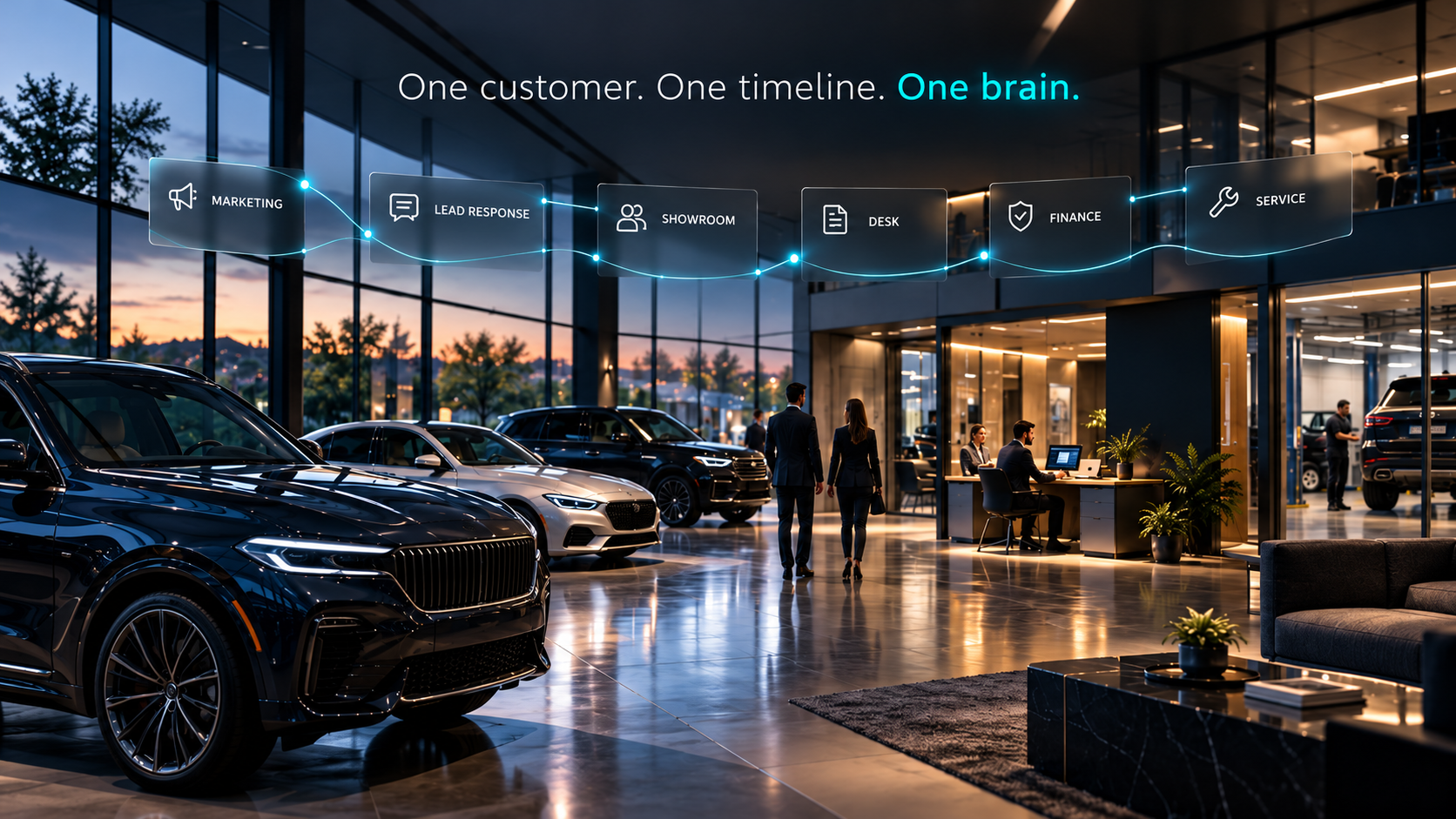
The customer who clicked on an advertisement should be the same customer your BDC engages, your salesperson meets, your desk structures a deal for, your F&I manager assists, and your service department welcomes months later.
One continuous customer relationship.
One connected history.
One dealership working together.
That is what meaningful AI transformation should look like.
The Future Belongs to Dealerships That Remember
I believe the next competitive advantage in automotive retail won’t come from having the most software.
It will come from making better use of the information dealerships already generate every single day.
The winners won’t necessarily be the stores with the biggest advertising budgets or the most aggressive AI marketing claims.
They’ll be the dealerships that respond faster, communicate better, make more informed decisions, retain customer knowledge, and consistently turn opportunities into stronger customer relationships.
AI won’t sell cars. People will.
But people equipped with the right intelligence, at the right time, can become dramatically more effective at what they do.
And that’s a future worth building.
Coming Next in the AI on the Lot Series
This is the first article in a series exploring how artificial intelligence can help improve the everyday operations of automotive dealerships.
We’ll walk through the dealership department by department, separating genuine business opportunities from technology hype.
We’ll discuss what works, what doesn’t, and why the best AI strategy always begins with understanding the people and processes behind the business.
Next in Part 2: The Lead That Got Away: Why AI-Powered Engagement Starts Before the Showroom.
Because before you can sell a car, you have to start a conversation.
And too many dealerships are losing that conversation before it ever begins.
About Dealer Velocity IQ
Dealer Velocity IQ was founded on a simple belief: dealerships don’t need more disconnected software. They need their existing systems, people, and customer information to work together intelligently.
Founded in Florida in 2026, Dealer Velocity IQ is an automotive technology company developing Dealer Velocity One, an AI-powered intelligence and orchestration platform designed specifically for automotive dealerships.
Rather than requiring dealerships to replace their existing CRM, Dealer Management System (DMS), desking applications, or other operational tools, Dealer Velocity One is designed to connect information across those systems and create a unified view of each customer’s journey.
At its foundation is Velocity Brain, the shared intelligence layer connecting customer activity, operational insights, and recommended actions across the dealership.
The platform’s modular vision addresses critical dealership functions, including marketing, customer engagement, showroom operations, deal structuring, credit workflows, finance, and service.
Its guiding principles are straightforward:
-
Connect, don’t replace. Build on the technology dealerships already use.
-
Empower employees. Use AI to support better human decisions, not eliminate human judgment.
-
Protect dealership data. Maintain appropriate security, access controls, ownership, and accountability.
-
Measure real business outcomes. Focus on operational improvements and measurable results, not AI hype.
Dealer Velocity One is currently in pre-launch development, with its initial focus on customer engagement and deal structuring.
Our mission is to help dealerships transform disconnected information into practical, trustworthy intelligence that improves efficiency, strengthens customer relationships, and supports profitable growth.
One Customer. One Timeline. One Brain.
Learn more at https://dealervelocity.ai
About the Author: Beshoy “Besho” Fadlalha
Founder & Chief Executive Officer | Dealer Velocity IQ
Beshoy “Besho” Fadlalha is an automotive retail executive and entrepreneur with more than 12 years of hands-on dealership leadership experience, including General Sales Manager responsibilities and direct involvement in the operational realities of selling, financing, and servicing vehicles.
Throughout his career, Besho has worked closely with sales teams, business development departments, desk managers, finance professionals, and dealership leadership to drive performance and deliver results.
His experience has given him a firsthand understanding of a challenge many dealerships face: talented employees working hard inside processes and systems that do not consistently share information.
He has witnessed valuable customer knowledge disappear between departments, promising leads lose momentum, managers spend hours gathering information, and opportunities slip away because the right person didn’t have the right context at the right time.
Those experiences became the inspiration behind founding Dealer Velocity IQ in 2026.
Besho recognized that the automotive industry didn’t need another isolated technology tool promising to revolutionize car sales. It needed a more intelligent way to connect the systems dealerships already depend on, preserve institutional knowledge, and help employees make better decisions.
By bringing together real-world automotive leadership and modern artificial intelligence expertise, he set out to help build technology designed around the way dealerships actually operate.
His philosophy remains simple:
“Technology should make great dealership people even better, not replace what makes them great.”
Through Dealer Velocity IQ and his AI on the Lot article series, Besho is focused on helping automotive leaders understand how practical, responsible AI can solve real dealership challenges and create measurable business value.
Connect with Dealer Velocity IQ: https://dealervelocity.ai